

GTM DIAGNOSIS
find the constraint before you add the tool.
use these questions to separate a messaging issue from a motion issue, and a people issue from the system around them.
the sentence on the first call.
every engagement opens with a symptom the client has already diagnosed. the diagnosis is nearly always the last place the damage showed up, not the place it started.
SCROLL SIDEWAYS TO COMPARE
| what we were told | what it actually was |
|---|---|
| "our outbound is down" | the meetings outbound produced were being lost at the handoff |
| "our sdrs are not converting" | acceptance was one account executive’s judgment, and it barely filtered on quality |
| "the ads are not working, we need more spend" | the account was counting map taps as leads on an untracked phone number |
| "our outbound team is underperforming" | the outbound team was not doing outbound |
four sentences from three engagements. none of the four clients was wrong about their business. all four were pointing at where the number moved rather than where the work was being lost.
CASE ONE
a booked meeting is not a finished job.
why is our outbound not producing meetings?
a 10-person sales development team at a b2b marketplace. the complaint was that outbound requested meetings were down, and outbound was where everyone was looking.
widening the lens to every channel, the real number was that only 64% of booked meetings were being accepted by an account executive at all. outbound was not an outlier in that table. it was one column in a report where every rep sat somewhere different, for reasons nobody had examined.
the reason was that every rep had invented their own handoff. some sent a calendar invite with no description. some wrote notes to their AE. some joined the call. some sent a follow-up that resold the meeting and introduced the AE inside it. the reps doing all of it converted best, and none of it was written down as a standard. a separate report showed roughly half the intro calls the reps booked, they were not attending.
201
MEETINGS A QUARTER LOST TO THE HANDOFF
1,003 meetings in the baseline quarter. acceptance went from 64% to 84% once the handoff was standardized, and 20 points of that volume is 201 meetings.
$35,175
PER QUARTER, AT THEIR OWN NUMBER
the internal value put on an intro call at the time was $175. that is roughly $140,700 a year, on a team that already existed. the 84% behind it is my own account of the closing number and i do not have the report, so read this as the size of the prize rather than a receipt.
every dollar spent producing more outbound would have gone into a handoff that was already losing a third of what it was given.
the full baseline table, and what happened to those ten people
CASE TWO
the account was counting the wrong thing.
how do i know if my google ads account is set up wrong?
a multi-location restoration franchise. the complaint was that the ads were not producing, and the assumed fix was more budget.
the account's own change history, exported with timestamps, showed what had been done to it in the month before we took it over. ten exact-match commercial-intent keywords removed in a single day, including the terms somebody types while their house is flooding. the ten-mile radius around the franchise's own city removed, and six geographies added that belong to neighboring franchises in the same family. the daily budget cut from $20 to $5.
then the live account, a month later. three conversions that week, and all three were "get directions." not one phone call. the call tracking display number did not match the destination number, so a phone conversion could not have fired even if someone had called. average cost per click was $12 against a $15 daily budget, which buys one click a day. some of the search ads carried urls pointing at other franchises' pages.
$14.73$9.45
COST PER CLICK, BEFORE AND AFTER
same budget, rebuilt configuration. 36% of every click dollar was being overpaid, which is 56% more clicks for the same money once it was fixed.
2035
QUALIFIED LEADS, TWO MONTHS EITHER SIDE
no increase in spend. the budget was never the constraint.
adding budget to that account would have bought more map taps, in other people’s territories, on a phone number nobody was tracking.
CASE THREE
the motion existed on the org chart and nowhere else.
why is our outbound team underperforming?
a travel technology platform with a commissioned outbound team in place. the complaint was performance.
the team was not doing outbound. they were working the accounts most likely to close on their own and calling it a pipeline. nobody had checked whether the activity everyone was managing actually existed, because the org chart said there was an outbound function and the reporting was about how that function was doing.
so the first test was not a coaching plan. it was to run the motion once and see what was there. one campaign, one list of 540 people attending a conference, sent from the client's own inboxes.
the first batch went out on a wednesday afternoon. this arrived at 4:45 the same day.
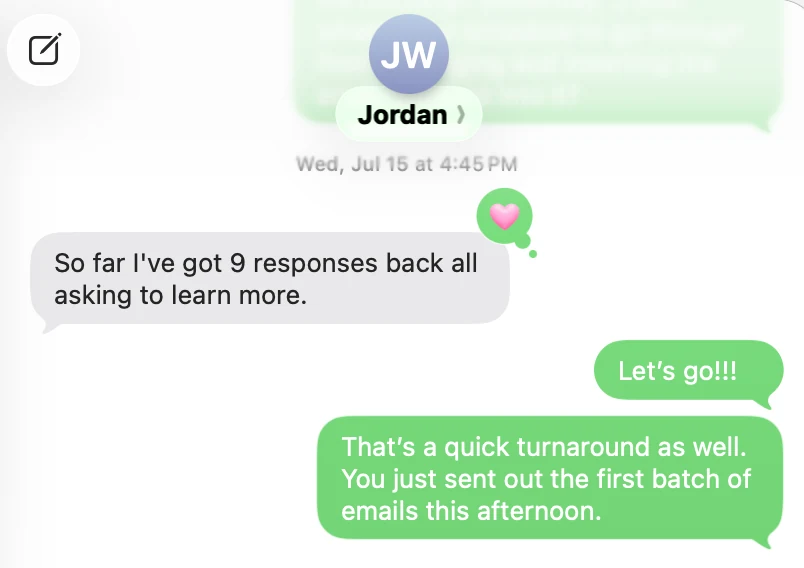
"So far I've got 9 responses back all asking to learn more."
the reply under it is mine: "that's a quick turnaround as well. you just sent out the first batch of emails this afternoon." nine replies, the same afternoon the first batch went out, from a motion the company already believed it was running.
9
REPLIES THE SAME AFTERNOON
all of them asking to learn more, hours after the first batch sent. this one is on the record above.
52%
EMAIL OPEN RATE
540 contacts, all of them attending one conference. relevance did the work that volume usually gets asked to do.
15
MEETINGS BOOKED FROM THE CAMPAIGN
2.8% of the list.
the fifteen meetings had been available the whole time. the cost of that diagnosis was every quarter nobody went and got them.
the nine replies are on the record above, published with the founder's permission. the open rate and the meeting count are reported from the engagement rather than from an exported report, and are attributed here rather than shown.
why the presenting complaint is usually wrong.
not because clients misunderstand their own businesses. because of where the evidence surfaces.
- the symptom appears where the measurement is
- a fault upstream shows up as a number downstream, because downstream is where the reporting is. outbound had a dashboard. the handoff did not.
- the number is counting something else
- meeting acceptance was measuring the relationship as much as the meeting. reported ad conversions were measuring map taps. in both cases the metric moved for reasons that had nothing to do with the thing it was named after.
- nobody checks whether the activity is happening
- the hardest one to see, because the org chart is evidence of intent and gets read as evidence of work. a team can exist, report weekly, and not be doing the thing.
- the obvious fix is more of the input
- more spend, more meetings, more activity. every one of those pushes more volume into the part that was already losing it, and the result is a bigger number in the same broken place.
- the thing exists, so it is assumed to be in use
- a launch produces artifacts. a page, a price sheet, its own info sheets. all of it is real, so the launch reads as finished. what goes unchecked is whether a rep will carry it into a call, and a rep who is not sure how it wins leads with the one they are sure about. full effort in the wrong direction, which is the one more input makes worse.
THE PART YOU CAN DO WITHOUT US
four questions, answerable from your own systems.
what should a go-to-market diagnostic actually look at?
these are the four that found the faults above. none of them needs an agency and all four are answerable this week.
- what is each number literally counting? open the conversion definitions and read them. not the dashboard, the definitions. this is the one that found the map taps.
- is the activity actually happening? pull the raw records, not the summary. sent emails, dials connected, meetings attended by the person who booked them. this is the one that found an outbound team doing no outbound.
- where in the sequence is the work being lost? follow one unit all the way through, from first touch to closed. a handoff is the most common answer and the least instrumented step.
- who would you rank differently than the report does? write the names down before you look. every place your judgment and the table disagree is a place the table is measuring something you have not named yet.
if all four come back clean, the presenting complaint was right and you should go work on it. that happens, and it is worth ten minutes to find out.
and if they do not come back clean, the first two weeks of an engagement here are the same four questions run properly, against your systems rather than your recollection. what comes out is a ranked list of where to invest first, and what to leave alone. the second half of that is the part most audits skip, and it is usually the more expensive half to get wrong.
A WORKING CONVERSATION