
A company gets acquired, or spins out of a parent, and somewhere in the following year the channel changes. Instead of selling direct to the end buyer, the motion starts running through the parent's account teams. Their reps have relationships you would spend three years building. Their logo answers the credibility question before you open your mouth.
Revenue goes up. That is the good news, and it is also the anesthetic.
I have watched this happen twice from inside, at two companies, six years apart. Both times I was brought in to revive outbound. Both times the honest answer turned out to be something else.
Borrowed distribution
I call it Borrowed Distribution, because the distribution is real and it is not yours. It sits next to a pattern I write about a lot: inbound masks operational weakness until pipeline slows. Same shape, different source. A partner channel starts producing, total revenue rises, and nothing in the reporting looks wrong, so nobody goes looking.
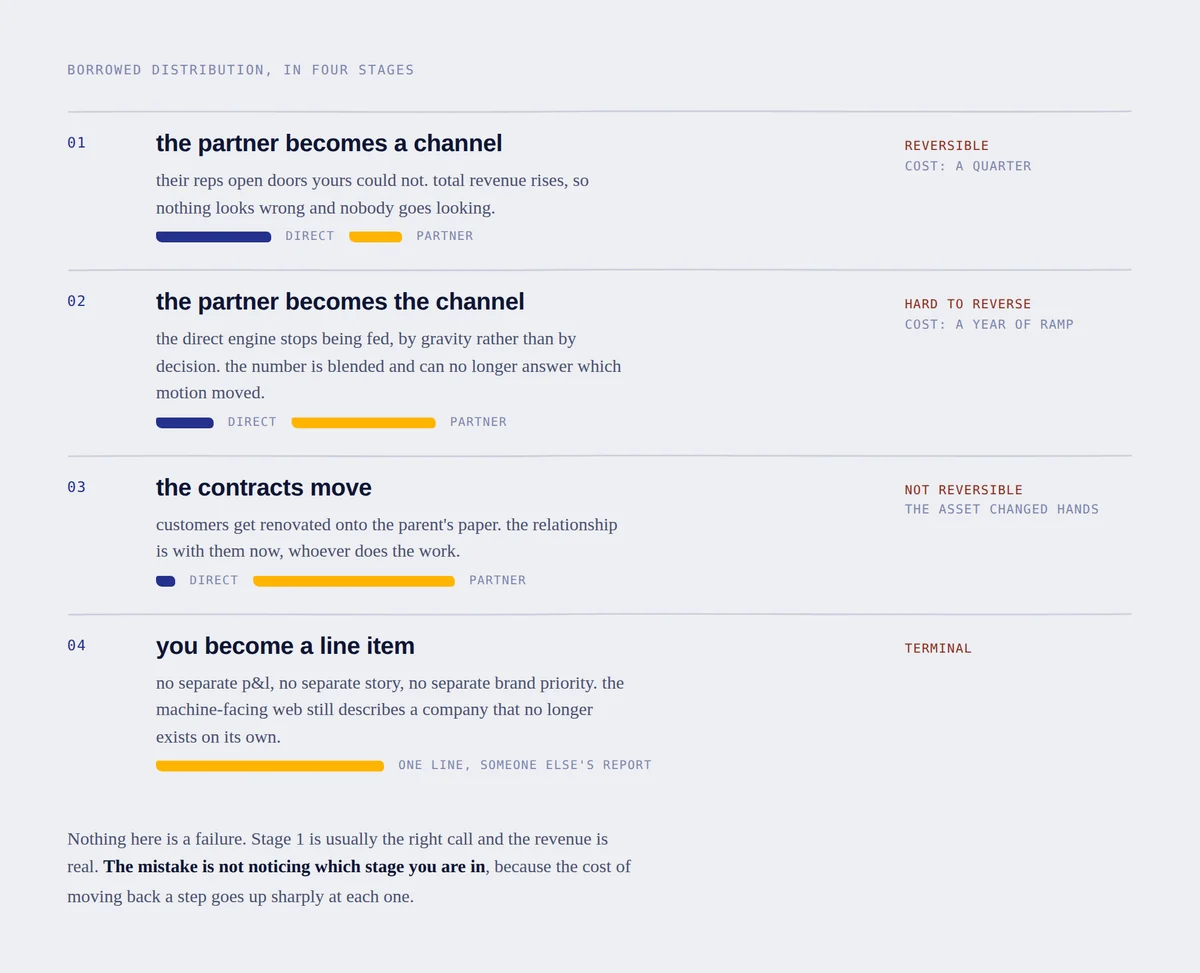
It moves in stages, and the cost of stepping back a stage goes up sharply at each one.
What happens underneath
The direct engine stops being fed. Not by decision. By gravity. Every hour has a better use when a warm partner-sourced meeting is sitting next to a cold list, so the cold list waits. Six months later the prospecting muscle is gone, and it went without a meeting ever being held about it.
And the number goes blended. "Revenue is up" is now true of two motions with different economics, different cycle lengths, and different failure modes, and one line on a dashboard cannot tell you which one moved. This is the same failure as counting form fills. The number rises and it is not telling you anything.
The fix is not complicated, it is just unpopular. Split the reporting before you need it: partner-sourced and direct-sourced as separate lines, with separate targets, from the first quarter the partner channel exists. Blended numbers are easy to produce and impossible to act on.
Twice I was hired to fix outbound, and twice I said do this instead
This is the part I did not expect, and it is why I do not write this as a warning.
At a talent marketplace owned by a global staffing group, and years earlier at a crowdsourcing platform that had been acquired into a large IT services firm, I was brought in to rebuild outbound. In both cases, a few weeks in, the same thing was true: the same hours spent feeding the partner channel produced more, faster, at better margin, than the same hours spent rebuilding cold outbound from a standing start.
So that is what we did. Streamline the intake and routing between the two organizations. Build the enablement. Make it easy for someone else's rep to sell your thing without having to understand your thing.
When the partner is the channel, your ICP is their sales team.
That reframe changes the work completely. Your enablement stops being customer-facing and becomes internal-facing. Your positioning has to survive being retold third-hand by someone carrying nine other products. Your one-pagers are not for buyers, they are for account executives with four minutes before a client call. Your case studies have to work as proof for someone else's pitch.
None of that is a smaller job than outbound. It is a different job, and most teams try to do it with materials written for a motion they no longer run.
Stage three is where it stops being reversible
The stage most people do not see coming is the contracts. When the parent acquires you outright, customer agreements get renovated onto the parent's paper. After that the relationship belongs to them regardless of who does the work, and there is no version of "let's rebuild direct" that recovers it.
Topcoder is the public version of this arc. Founded in 2001 and independent for over a decade, acquired by Appirio in 2013, then acquired along with Appirio by Wipro in 2016 as part of a $500 million deal. It still operates inside Wipro today. That is not a criticism of any of those decisions. It is what stage four looks like from the outside: a brand that was its own company becomes a capability inside a much larger one.
The half of a rebrand nobody owns
Stage three and four usually come with a brand change. The parent's name moves to the front, yours moves to the back, and the website gets rewritten to match. That part is visible, budgeted, and someone owns it.
What nobody owns is the half of your site that is not written for people.
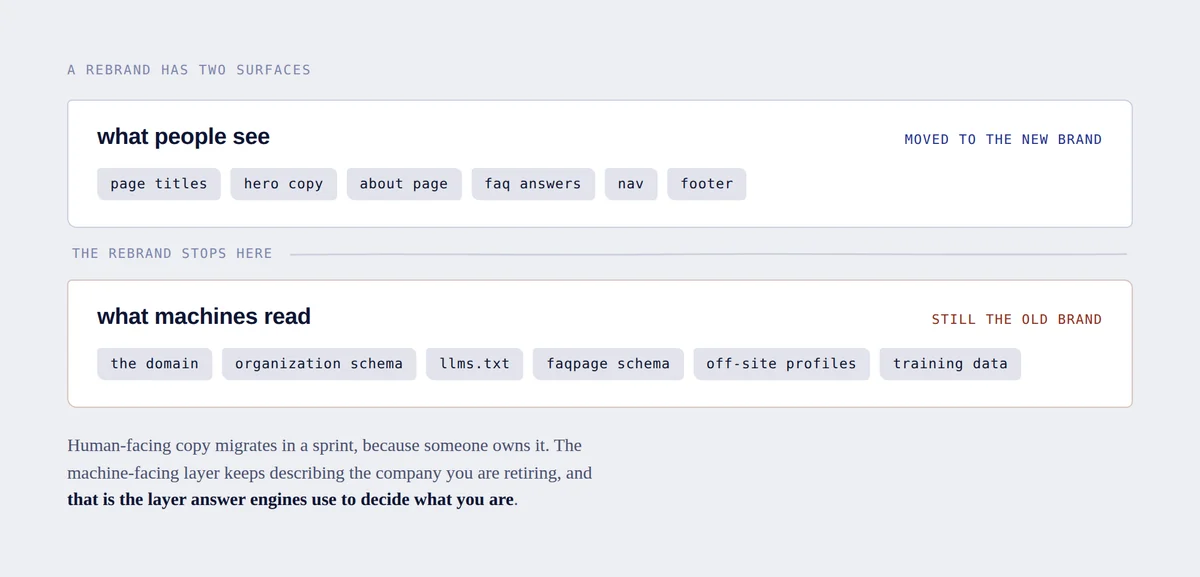
If your old brand has been around a few years, AI models already know it. It is in training data, in earned media, in conference listings and review sites and a few hundred blog posts. Retire the name from your copy without doing anything else and none of that transfers. Engines keep answering questions about the old entity from stale data and never learn it is the same company. You have not moved your equity. You have orphaned it.
Search solved this problem twenty years ago and called it a redirect. There is no redirect for an entity. You have to state the relationship, in language, somewhere a crawler reads:
- A definitional sentence. In plain words: "[Old name] is the platform behind [new name]." Engines learn entity relationships from exactly this construction, and most sites do not have it anywhere.
- Organization schema. The parent as the organization, the old name as
brandoralternateName,sameAspointing at LinkedIn, Crunchbase and the parent domain. The machine-readable version of that sentence. - llms.txt. If you have one it was written before the rebrand and it opens with the wrong company name. That file exists to tell models what to say about you, so it is a strange thing to leave aimed at the brand you are retiring.
- One name per thing. An engine cannot cite "the community" any more than Google could rank "the website." Pick the proper noun and use it identically everywhere, including off-site.
- Numbers that agree. Check your homepage against your pricing page against your llms.txt. If one says 3M and another says 2.3M, an engine either picks one at random or trusts neither.
Rebrands often ride along with a rebuild, and the rebuild often means a new platform. I have watched a site move from Webflow to Framer in exactly this situation, and the result was better in every visual way. What does not survive that move is anything added as custom code. Framer does not generate JSON-LD for you, so any Organization, FAQPage or Article schema left with the old theme, and nothing in the new builder mentions it. Verify with Google's Rich Results Test rather than assuming. A rebuild is exactly when this disappears and exactly when nobody is looking for it.
What I would do this quarter
Work out which stage you are in, honestly, and then decide on purpose. If you are at stage one or two, split the reporting into partner-sourced and direct-sourced and set a floor on direct. Not a target you will hit. A floor you will notice breaching. That is what makes atrophy visible while it is still cheap.
If leaning into the partner channel is the right call, and often it is, then resource it like a channel instead of treating it as free revenue. Enablement built for their reps. Materials that survive third-hand retelling. Someone who owns the relationship the way you would own a territory.
And if the brand is moving too, spend an afternoon on the machine-facing layer before the old entity goes cold.
Borrowed distribution is still distribution. Just know which stage you are in, and do not confuse it with a motion you own.