
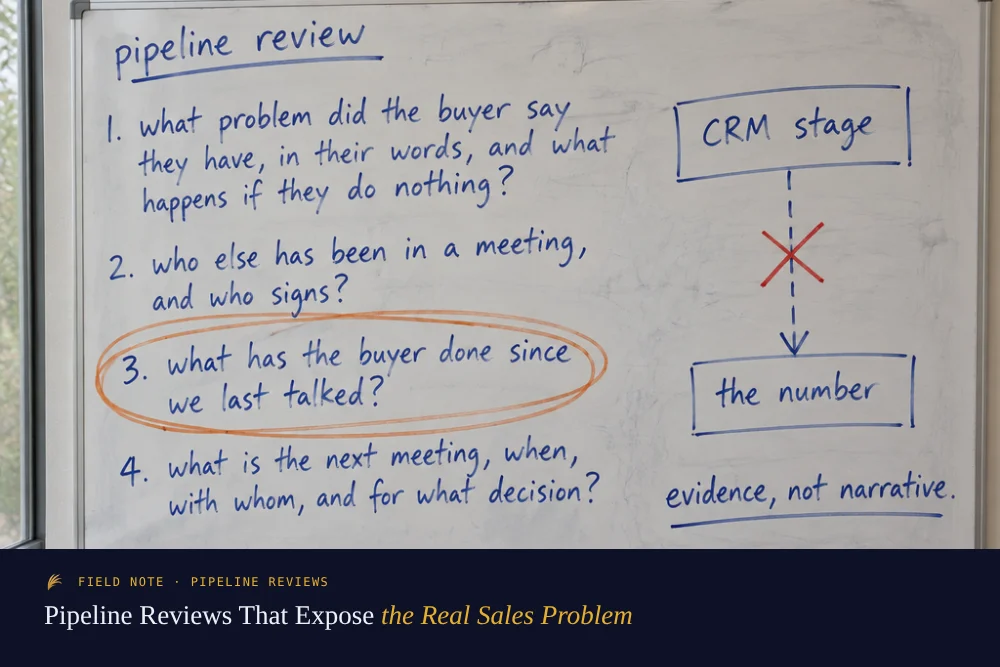
Let's talk about how to run an effective pipeline review with your sales reps. The meeting is called a "pipeline review" and, yet, often times nobody reviews the actual "pipeline".
They review a forecast number. They review rep confidence. They review whatever moved in Salesforce since last Friday. Then everyone leaves with the same deals, the same vague next steps, and a cleaner explanation for why the quarter slipped.
Here's what that costs: On one SDR team I measured, 1,003 booked meetings in a quarter, the share the account executive accepted ran from 47% to 90% depending on which rep booked it. Same product, same AEs, same quarter. In the weakest column, more than half the meetings were not deals the AE would take. If that pipeline went to the board, so did the opinion.
In a separate engagement, I ran this meeting every week as the interim BD leader on a mid-market SaaS team, and for years before that on teams I built. What follows is what I inspect, and what moved when it was inspected.
A useful pipeline review makes the work uncomfortable in a productive way. It shows where the sales motion is breaking, who owns the repair, and what changes before the next meeting. The point is not to embarrass a rep over thin deal notes. The point is to stop you planning capacity, hiring, and what you tell the board around pipeline that is not there. If you answer for the number, this is the one hour a week where the forecast gets tested before the board tests it.
The short answer
A pipeline review tests the evidence behind each deal. Four things: a problem the buyer said they have, the people who have actually been in a meeting, the work the buyer has done since you last talked, and a next meeting with a date, attendees, and a decision. A forecast call asks a different question: what number do we commit to. I run them as two questions, in that order. Mixed into one meeting, reps defend deals instead of exposing risk. The review is working when it changes how reps qualify, how managers coach, and how much you trust the number you carry upstairs.
What is a pipeline review for?
Most pipeline reviews exist to satisfy leadership. I use mine as a management system. It inspects three things: deal quality, seller behavior, and the assumptions under the forecast you are about to sign.
CRM stages are not evidence. A deal marked "discovery complete" does not prove the buyer has a problem worth solving. A late-stage opportunity does not prove access to the economic buyer. A close date does not get more credible because it has been carried forward three times.
When I sit in a review I want two things. What changed in the buyer's world since the last conversation. And the next meeting: the date, who is in it, and what decision it advances. A rep who cannot answer those plainly has a deal that is not where the CRM says it is.
Two hundred dials in a day, no email logged, no disposition. That was the record on a mid-market B2B SaaS team this fall. The engagement platform had quietly stopped writing activity back to the CRM, and the reports understated most of the team for a quarter. Nobody was lying. The pipe, itself, was broken. So the first question in a review is whether the record can be reviewed at all. Fix the pipe before you read the gauge. Until then the review is a meeting about a spreadsheet.
What should a pipeline review cover?
Most leadership teams open the CRM, sort by amount, and work down the largest opportunities. That makes a long meeting and a shallow diagnosis.
I start with the sales motion. What has to be true for an opportunity to move from qualified to evaluation, or from evaluation to commercial review? Which buyer roles have participated? What problem has the prospect agreed to solve? What event creates urgency? What work remains on the customer's side? Those are the exit criteria that make stages useful. Without them, a stage is a rep's opinion.
The criteria should fit the company's actual sale. A founder-led motion at $0 to $1M ARR needs different inspection than a mid-market company selling through five stakeholders. The mistake is treating that difference as permission for looseness. The deal complexity changes. The need for evidence does not.
Half a percent. That was the connect rate on event follow-up calls on that same team, because the lists marketing had paid for had been exported into a spreadsheet nobody owned. Once those accounts had a rep, a reason, and a phone call, 12% connected. So the review also covers the accounts that should be in the pipeline and are not: if marketing is paying for intent data and event lists, the review asks how many of those accounts a rep has touched this month.
The usual shape is one queue feeding all SDR activity, with no clarity on account type, buyer role, or ownership. I replace it with named working lists. One per kind of work. Each with an owner and a reason it exists. Then a manager can read activity and conversion by the work being done instead of asking why the whole queue is underperforming. Pipeline quality begins before an opportunity is created.
What questions should you ask in a pipeline review?
A rep can tell a convincing story about a deal that has no path to close. A good review forces a gap between what the rep believes and what the buyer has actually done.
For each material opportunity there are four questions. Your manager asks them. You listen for whether the answers are evidence or narrative. Asked in the room, word for word:
| The test | What the rep offers | What the review asks |
|---|---|---|
| Qualification | "Interested." "They liked the demo." | What problem did the buyer say they have, in their words, and what happens if they do nothing? |
| Stakeholder coverage | One friendly champion | Who else has been in a meeting, and who signs? |
| The mutual process | What the rep has sent | What has the buyer done since we last talked? |
| The next step | "Follow up next week" | What is the next meeting, when, with whom, and for what decision? |
Qualification means a defined problem and a reason to act
"Interested" is not qualification. "They liked the demo" is not qualification. A qualified opportunity has a problem the customer recognizes, a consequence for leaving it unresolved, and a reason the work has priority now.
In HR tech and talent tech, a process headache gets called pain. The question you want to hear asked in the room, word for word: "Is this tied to a hiring plan, compliance exposure, recruiter capacity, or a leadership mandate, and who feels the cost if nothing happens?" No answer means it is a conversation, not an opportunity. It does not go in your number.
Stakeholder coverage reveals hidden risk
One friendly champion is not buying consensus. The review should expose who has been engaged, who has not, and whether the rep knows how the decision will be made. Has the economic buyer been identified? Has anyone with implementation, security, finance, or procurement responsibility entered the process where it matters? Is the champion carrying the whole case internally because the seller has not earned broader access?
When to push for the buying group depends on the stage. What you listen for is whether the team knows what it is looking for at each one. A late-stage deal with one contact is the surprise objection you will hear about on the forecast call.
The mutual process shows who is doing the work
A mutual process is the work both sides have agreed to do between now and a decision: the pilot scoped, the security review started, the reference call on the calendar, the business case drafted with the champion. Count who owns each item. If every item is the seller's, there is no mutual process, there is a follow-up schedule. The review asks what the buyer has done since the last meeting, not what the rep has sent.
A next step must move the buyer forward
"Follow up next week" belongs in a task list, not a pipeline review. A meaningful next step has an owner, a date, attendees, and a stated purpose. It advances a buyer decision or completes a specific piece of mutual work. If the next meeting has no clear outcome, the rep is hoping momentum will show up on the call.
Hope is not a deal strategy.
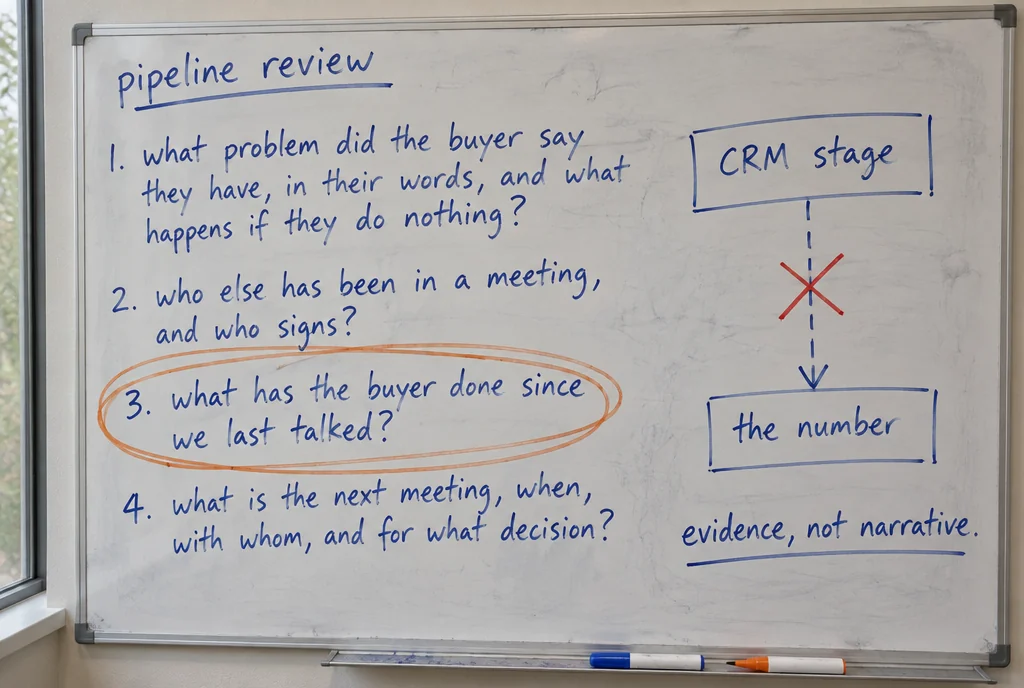
Ask those four across a whole team and you get the spread from the top of this post, 47% to 90%. Standardize the qualification and the handoff and the number moves. On that team, accepted meetings went from 64% to 84%. Two caveats travel with it: the acceptance criteria were tightened in the same window, and the roster changed. The full table, rep by rep, is on the research page. A stage is a rep's opinion until the test is the same for everyone.
What is the difference between a pipeline review and a forecast call?
The fastest way to ruin a review is to run it as a forecast call. Once reps believe every weak detail cuts their number, they defend deals instead of exposing risk. You get a number you cannot trust, because it was defended rather than tested.
You still hold people to forecast accuracy. I separate the questions. First: what evidence supports the stage and the close date? Then, on that evidence: what belongs in commit, best case, or pipeline? This changes the room. A rep can say "I don't have economic buyer access yet" without manufacturing certainty. The manager can coach the gap before it becomes a miss.
Leaders own their part of this. A manager who keeps accepting vague close plans, inflated stages, and missing notes is teaching the team that the record is optional. Most SDR problems are management problems. The same is true of pipeline discipline.
What should come out of a pipeline review?
The common failure is a meeting that ends with good insight and no changed behavior. "We need better discovery" is an observation. "Use the revised discovery scorecard in Gong and review two calls in Wednesday's one-to-one" is work.
Every action leaves the room with an owner and a date. A deal may need executive access. A rep may need a multithreading plan. A manager may need to inspect call quality because the same qualification gap shows up across several deals. When the pattern is broader than one deal, the fix belongs in the system. I have used a call-scoring rubric in Gong to make discovery coaching concrete, then made it the thing we look at in the one-to-one, with the call and the record open. The artifact matters because it outlives the manager's memory.
The clearest system fix this year was a handoff. Account executives were declining or skipping the meetings the BDRs booked. Every rejection sounded different, because nobody had written down what a booked meeting has to arrive with. The fix was not coaching one rep. It was a written agreement between the two roles: what a meeting carries, what the AE owes back, and a warm handoff with an introduction email, a prep brief, and the BDR on the first call. That handoff is now the method on the SDR leadership page. It is the same mechanism the research page found behind the 47% to 90% spread. The review is where the agreement gets enforced every week, deal by deal.
A review should also surface what is outside the rep's control. Lead routing delays, disconnected lifecycle definitions, bad enrichment, and unclear handoff rules create pipeline problems coaching cannot fix. Tools amplify clarity or confusion. They never fix it.
How do you know a pipeline review is working?
84% of sales leaders said sales analytics had less influence on sales performance than leadership expected. Gartner asked 303 of them in 2023. That is what a chart nobody acts on looks like from the top. The output of a stronger review is not a prettier dashboard. It is a visible change in deal quality, then in throughput.
8% to 25%. That is the share of outbound opportunities that qualified in the first sixty days of the engagement on that team, measured against the sixty before, on a team that went from four reps to three halfway through the window. Outbound qualified pipeline went from 1x to nearly 4x in the same window. Demo requests that qualified moved too, 56% to 64%, because the same test was applied to inbound. Every figure comes from the client's own CRM and engagement-platform exports, and the case study carries the method.
The review is where those numbers got read every week. It is also where the other number got said out loud: the count of meetings did not move the same way on a smaller team. Conversion moved first. Volume is the next job.
That is the standard. If the meeting does not change how reps qualify, how managers coach, or how much leadership trusts the forecast, it is administrative theater.
What the review owes the board
A pipeline review has two readers, and you are often both. The manager in you wants the deal, the gap, and the coaching. The person who answers to the board wants the last two sentences: which number moved, why it matters, and where it lands at plan and at eighty percent of plan. Walk into the board meeting with the manager's notes and you have brought a list of what shipped. The review's last five minutes belong to the bucket, not the deal.
Make the system transferable
I build go-to-market motions, then run them with the team until the operating rhythm holds. The pipeline review is part of what gets handed over. The company owns the CRM definitions, the working lists, the scorecards, and the meeting itself. A written operating handoff says who runs the review and what gets inspected. Nobody should need me in the room for it to work.
Heroic sellers can carry a quarter. They cannot create reliable visibility across a revenue organization.
Systems beat heroics.
Questions people ask
What should a pipeline review cover?
The sales motion first, then the deals. For each material opportunity, four questions: what problem did the buyer say they have, and what happens if they do nothing; who else has been in a meeting, and who signs; what has the buyer done since we last talked; and what is the next meeting, when, with whom, and for what decision. CRM stages are not evidence. The answers to those four questions are.
What is the difference between a pipeline review and a forecast call?
A pipeline review asks what evidence supports the stage and the close date. A forecast call asks what belongs in commit, best case, or pipeline. Combine them and reps defend deals instead of exposing risk, because every weak detail cuts their number. Ask the evidence question first, then the forecast question on that evidence.
What makes an opportunity qualified?
A problem the customer recognizes, a consequence for leaving it unresolved, and a reason the work has priority now. "Interested" and "they liked the demo" are not qualification. If the rep cannot say who feels the cost and what happens if the buyer does nothing, it is a real conversation and not a real opportunity.